Go directly to main content
Show navigation
Hide navigation
Research
Hide navigation
Research groups
Instrumentation groups
Research Projects
Publications
Studies
Show navigation
Outreach
Show navigation
About Us
Show navigation
Staff
Infrastructure
History
Astro Intern
Information for ...
Hide navigation
Prospective students
External link
Students
External link
Researchers
External link
Continuing education
External link
Alumni (in German)
External link
Most searched-for services ...
Hide navigation
Studying at the University of Vienna
External link
u:find Course / Staff search
External link
Webmail
External link
Intranet for employees
External link
u:space
External link
Library
External link
Moodle (e-learning)
External link
Faculties & centres
External link
Contact & services from A to Z
External link
en
Language selection
Deutsch
Show search form
Hide search form
Quick links
Websites
Staff search
Search
Research
Studies
Outreach
About Us
Department of Astrophysics
en
Language selection
Deutsch
Search
Websites
Staff search
Start search
Quick links
Information for ...
Prospective students
External link
Students
External link
Researchers
External link
Continuing education
External link
Alumni (in German)
External link
Most searched-for services ...
Studying at the University of Vienna
External link
u:find Course / Staff search
External link
Webmail
External link
Intranet for employees
External link
u:space
External link
Library
External link
Moodle (e-learning)
External link
Faculties & centres
External link
Contact & services from A to Z
External link
Department of Astrophysics
Research
Studies
Outreach
About Us
You are here:
University of Vienna
Faculty of Earth Sciences, Geography and Astronomy
Department of Astrophysics
Research
Research at the Department of Astrophysics
©Malika Duffek
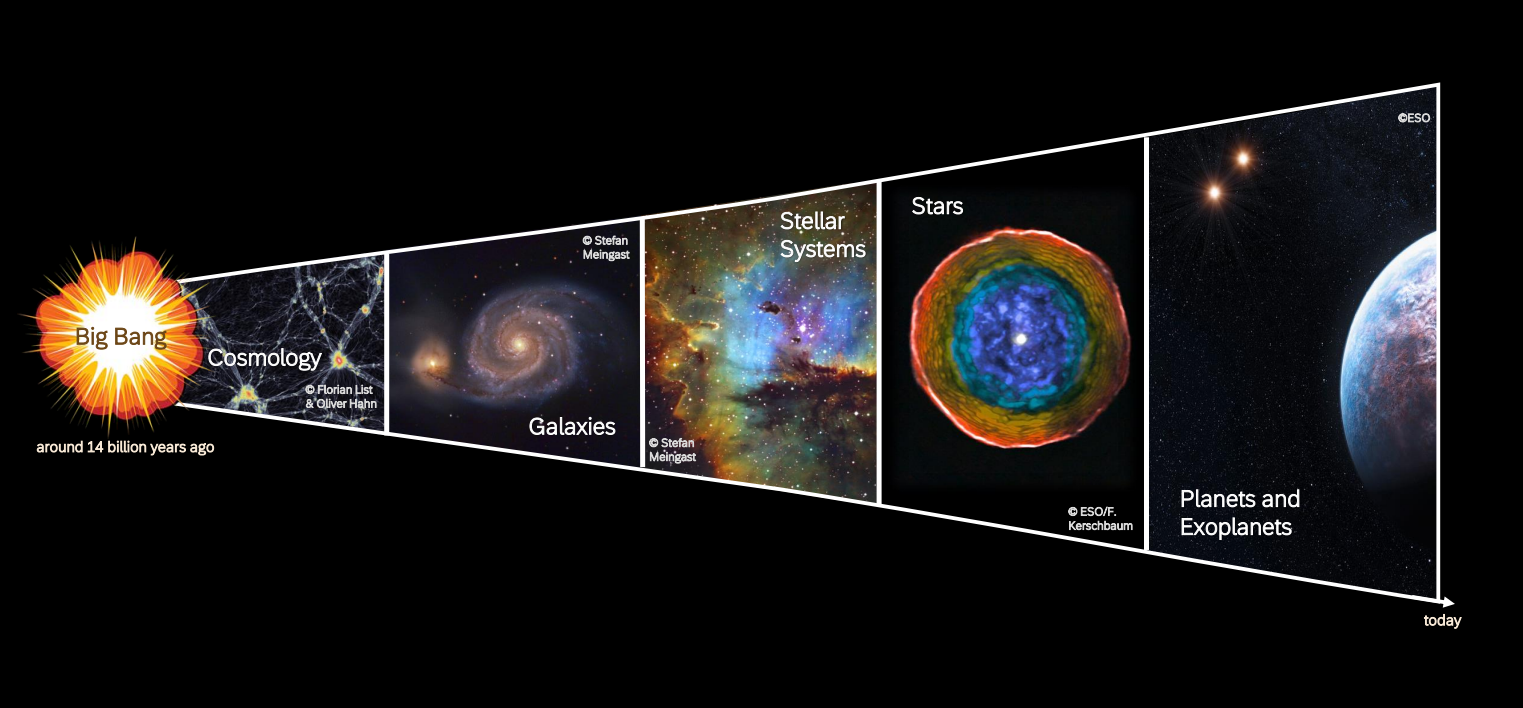
Research groups according to topic
Cosmology
Data Science in Astrophysics and Cosmology
Galaxies
Extragalactic Astrophysics
Dynamics of Stellar Systems
Stellar Systems
Dynamics of Stellar Systems
Interstellar Medium and Star Formation
Interstellar Medium Astrophysics
Stars
Late Stages of Stellar Evolution
Interstellar Medium and Star Formation
Star- and Planet Formation
Exoplanetary Atmospheres
Planets and Exoplanets
Exoplanetary Atmospheres
Star and Planet Formation
Instrumentation
Space-based
Space Instrumentation
Ground-based
A*- Vienna
Leopold Figl-Observatory
Research
Research groups
Instrumentation groups
Research Projects
Publications