
A minor planet and two asteroids named after researchers at the Institute of Astrophysics

Feier am Institut für Astrophysik. Von links nach rechts: Franz Kerschbaum, Elke Pilat-Lohinger und Rudolf Dvorak.
Can you imagine looking up at the sky and being able to point out a minor planet or an asteroid named after you? Our colleagues Franz Kerschbaum, Elke Pilat-Lohinger and Rudolf Dvorak now know what that feels like.
Minor planets and asteroids in the Solar System are not named after their discoverers. Instead, their names are assigned by the Working Group for Small Bodies Nomenclature (WGSBN) of the International Astronomical Union (IAU). This is often a way of honouring astronomers who have made outstanding contributions to research in the field of small celestial bodies.
In the most recent round of naming, Franz Kerschbaum was honoured with a minor planet, whilst Elke Pilat-Lohinger and Rudolf Dvorak were each honoured with an asteroid. The asteroid belt now features (278417) KERSCHBAUM, (20598) PILAT-LOHINGER and (13107) RUDOLFDVORAK.
Orbits

Umlaufbahn des Kerschbaums.

Umlaufbahn des Asteroiden PilatLohinger.
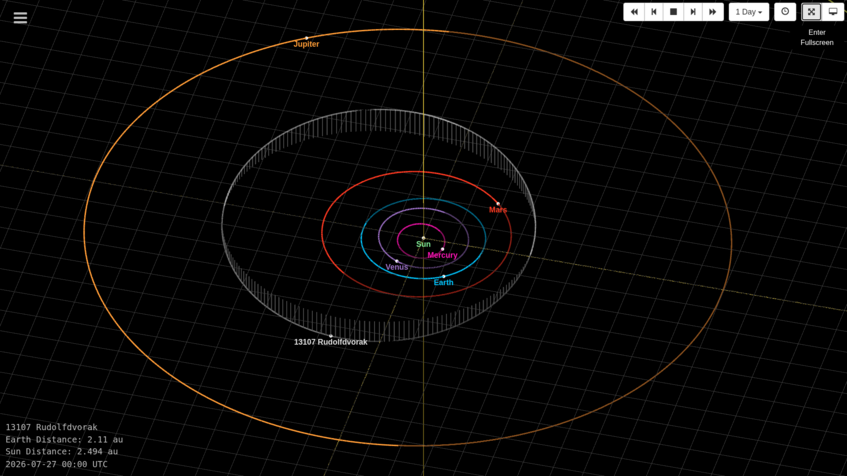
Umlaufbahn des Asteroiden RudolfDvorak.
(278417) KERSCHBAUM has a magnitude of 15.98 and a diameter of 2.3 km. The minor planet is located at a distance of approximately 2.96 astronomical units (AU) from the Sun and has an orbital period of around 5.11 years. Its orbit has an inclination of just 8° to the ecliptic and a low eccentricity of 0.06.
(20598) PILAT-LOHINGER has a magnitude of 14.1 and a diameter of 4 km. The asteroid is situated at a distance of approximately 2.8 astronomical units (AU) from the Sun and has an orbital period of around 4.7 years. Its orbit has an inclination of just 3.3° to the ecliptic and a low eccentricity of 0.11.
(13107) RUDOLFDVORAK has a magnitude of 13.8 and a diameter of 5 km. The asteroid is situated at a distance of approximately 2.5 AU from the Sun and orbits it in around four years. Its orbit has an inclination of 10.3° to the ecliptic and an eccentricity of 0.3.
Our colleagues have thus been ‘immortalised’ in the solar system, so to speak, and now belong to a select group of astronomers from the Institute after whom small celestial bodies have been named. The Vienna University Observatory has a long tradition of research into the Solar System. Other astronomers whose names have been immortalised in this way include Maximilian Hell, the observatory’s first director; Johann Palisa, who discovered more than 120 asteroids using the observatory’s telescopes; Anneliese Schnell, who was deeply committed to preserving the history of Central European astronomy; and Alois Purgathofer, who designed the Leopold Figl Observatory.
On 6 October 2026, we celebrated our colleagues at the observatory.


